The
central land channel (MLK) branches with Bergeshoevede in the proximity
of Rheine from the Dortmund Ems channel and ends after about 320 km
length with Magdeburg at the Elbe. It connects the stromgebiete
of the Rhine, the Ems, the Weser and the Elbe as central part of the
only west east water way of Northern Germany and makes beyond that the
connection to Berlin and to the Eastern European water ways.
Beside the industrial areas affected directly by the MLK Ibbenbueren,
Minden, Hanover, Braunschweig and Magdeburg tie up pass channels after
Osnabrueck, Hanover lime trees, Hanover Misburg, Hildesheim and salt
lattices further important industrie and trade areas to the MLK.
The central land channel (MLK) branches with Bergeshoevede in the proximity of Rheine from the Dortmund Ems channel and ends after about 320 km length with Magdeburg at the Elbe. It connects the stromgebiete of the Rhine, the Ems, the Weser and the Elbe as central part of the only west east water way of Northern Germany and makes beyond that the connection to Berlin and to the Eastern European water ways. Beside the with the building of the MLK between Bergeshoevede and Hanover in the year 1906 one began. On the channel section to Minden, first as Ems Weser channel designation, traffic was taken up on 15 February 1915. East of Minden the work in the autumn could be locked 1916 to Hanover. The area Osnabrueck was reached by means of 14 km a long pass channel with two air-locks. A further pass channel led after Hanover lime trees, while in Minden the connection channel north with the schachtschleuse as well as the connection channel south created the connection to the Weser with upper and lower one air-lock. The losses of water of the MLK due to air-lock enterprise, evaporation and infiltration are replaced with the main pumping plant Minden, the Weser water in the 13 m channel lain more highly promote. In order to adjust and thus disadvantages for navigation and landeskultur in the Weser area to avoid be able these water withdrawals, 1908 to 1914 the Edertalsperre (202 millions m³ reservoir) became and 1912 to 1923 (with war-conditioned interruption) the Diemeltalsperre (20 millions m³) establishes.
Briefly after the end of the 1. World war the work was advanced for the building of the MLK also as work-providing measure for dismissed soldiers eastward of Hanover. 1928 was given the Hindenburgschleuse in Anderten as well as the pass channel after Hildesheim freely, 1929 were reached the port Peine, 1933 the Braunschweiger port. With the completion of the air-lock Suelfeld as well as the ship lift Rothensee with Magdeburg finally the central land channel could be finished placed 1938. Over the Elbe Havel channel and the water ways east Berlin was manufactured also the connection to or. The idea was to create a continuous water route between west and East Germany reality become. In the years 1938 to 1941 still the industrial area salt lattice with 15 km a long pass channel was then attached to the MLK.
The channel bridge over the Elbe could not be finished placed however any longer. The work was war conditionally stopped 1942, after already substantial foundation works for the bridge and the double lifting work Hohenwarthe were posed. Still today the navigation must descend toward Berlin over the ship lift Rothensee and/or shortly over in air-lock building-present the Rothensee to the Elbe, water level-dependently about 10 km downstream drive, in order to then arrive over the air-lock Niegripp into the Elbe Havel channel. In the summer months the low water levels of the Elbe lead thereby to substantial impairments of the goods traffic. Planning for the channel bridge over the Elbe was again taken up after the combination of both states; the channel bridge as well as the double air-lock Hohenwarthe are to be finished placed in the year 2003.
The MLK and its pass channels cross 385 bridges as well as 228 Dueker and passages, with which waters and traffic routes are under-led.
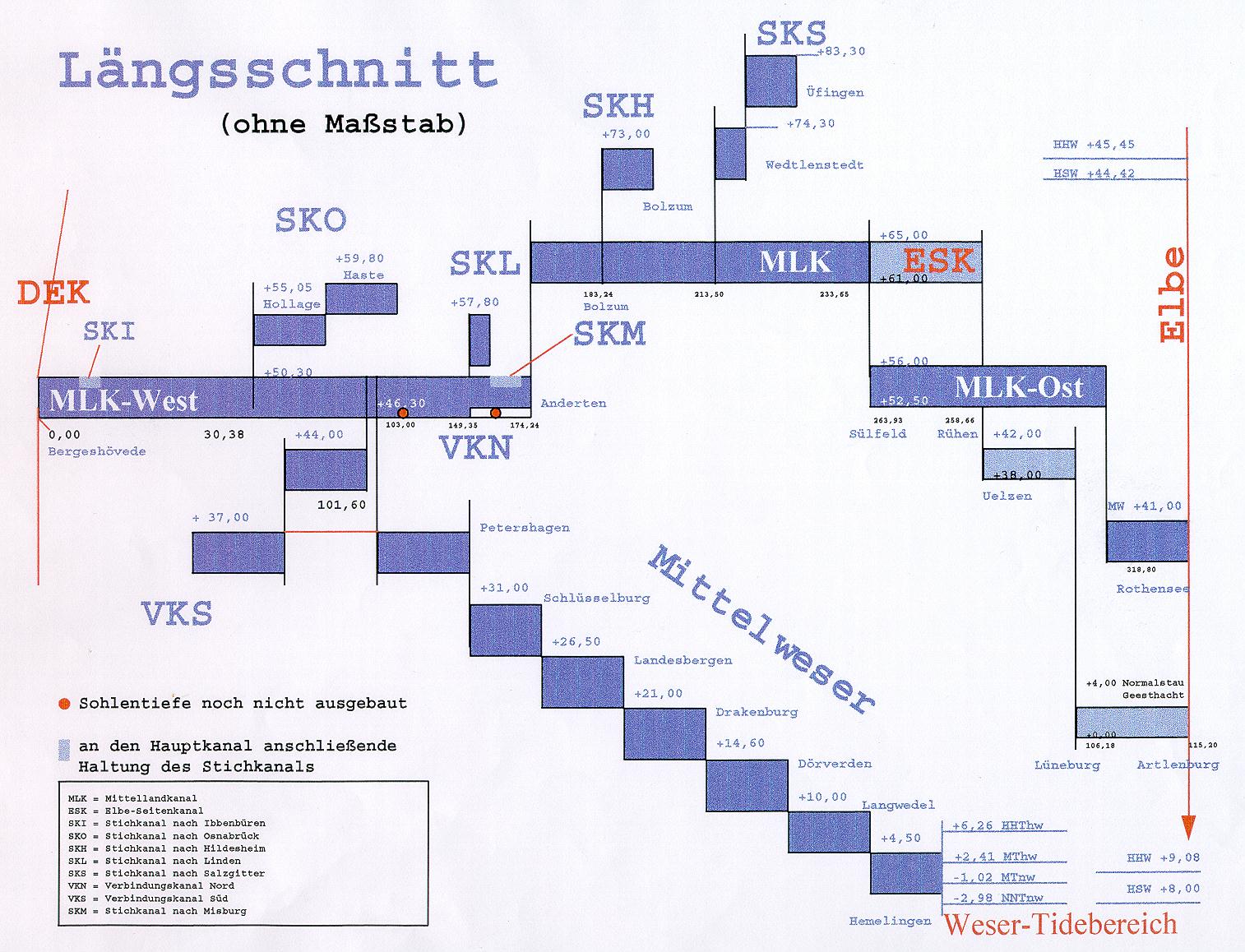
In order to interconnect Ems, Weser and Elbe, the MLK must overcome two wasserscheiden between these river basins. Because of its western beginning with Bergeshoevede at the Dortmund Ems channel the water level of the MLK is to 50.30 m. the wasserscheide on NN + between Ems and Weser overcomes it without air-locks. The Weser is crossed with Minden with a channel bridge. East the Weser runs the channel still on the height of NN + 50.30 m, crosses the line and a tide hollow of the line on in each case a bridge and rises only with the Hindenburgschleuse in Anderten into its vertex attitude with a water level height of NN + 65 m. with the air-lock Suelfeld west of wolf castle ends the vertex attitude; the MLK changes here into its east attitude on the water level height NN + 56 m, which will only leave in the future with Hohenwarthe east the Elbe again. The goal, the number of expensive and maintenance-intensive air-locks, which mean also time delays for the navigation to keep small was achieved with the drawing of the MLK in exemplary way. The western attitude is 174 km long. If one includes the attitude Bergeshoevede cathedral of the Dortmund Ems channel being on the same water level height of NN + 50.30 m, then a haltungslaenge of 211 km even results. Also the vertex attitude of 63 km length and those over 80 km long east attitude make possible a brisk driving fashion for the navigation.
The MLK was built west of Hanover for a traffic with 600-t-Schiffen. One however with regard to the future already planned the possibility of raising the water level around 50 cm of making the traffic possible with 1.000-t-Schiffen. East of Hanover the MLK was already from the beginning built for the 1.000-t-Schiff with 9,00 m broad and 2.00 m depth. The duct cross section was a hollow profile with water depths in the center of 3,00 m -3.50 m and water level widths between 31 m and 39 m; the water-prominent cross section was large up to 90 m².
A traffic volume had been at the basis put to planning for the building of the MLK by 8,8 million tons per year. Already toward end of the 30's traffic reached however 12 million tons per year and to today on approximately 22 millions t increased. Of it approx. 6 millions t are allotted to the transit traffic and approx. 16 millions t to the area traffic, i.e. a traffic, which begin or end in the ports of the channel. The area traffic from today more than 70 % shows, what large influence the channel on the economic development of its surrounding field has. All traffic prognoses forecast, in particular after the re-establishment of the German unit and after opening of the Eastern European countries, a further clear traffic increase.
The traffic development was accompanied by a fundamental change in the inland waterway craft travel. The slowly driving schleppzuege disappeared completely, the traffic capacities today by self-propelled engine goods ships and thrust federations were furnished. These larger and also faster ships caused a load of the channel bed together with the risen number of vehicles, for which it was by far limited. Constant uferabbrueche and the deposit of the eroded material on the kanalsohle were the result. Modern engine goods ships could use usually only 70 % of their load-carrying capacity because of the existing restriction of depth.
 Therefore
1965 became the central land extension of canals for the European ship
in such a way specified with 1.350 t load-carrying capacity with 80 m -
85 m length, 9.50 m broad and 2.50 m unloading depth decided and in an
intergovernmental agreement between the federation and the countries
involved fixed. For traffic with this vehicle-developed
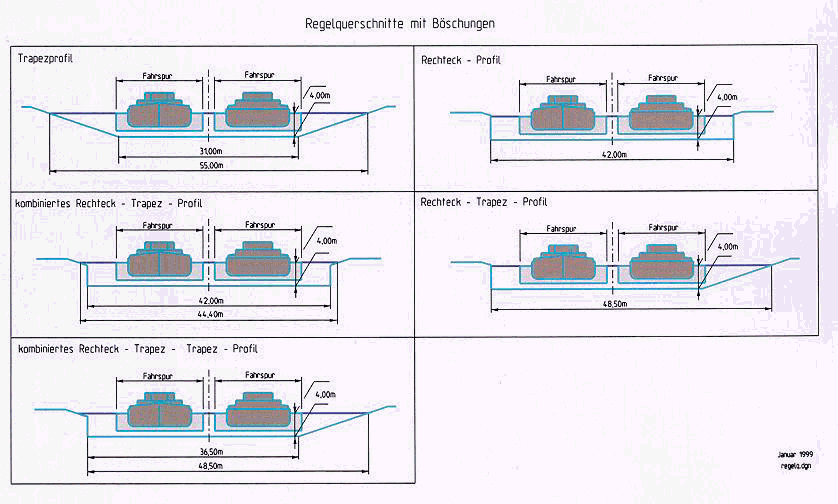
regelquerschnitte exhibit depth of water water level widths between 42
m and 55 m with 4,00 m; they are about double thereby sogross
like the original cross section of the MLK.
Therefore
1965 became the central land extension of canals for the European ship
in such a way specified with 1.350 t load-carrying capacity with 80 m -
85 m length, 9.50 m broad and 2.50 m unloading depth decided and in an
intergovernmental agreement between the federation and the countries
involved fixed. For traffic with this vehicle-developed
regelquerschnitte exhibit depth of water water level widths between 42
m and 55 m with 4,00 m; they are about double thereby sogross
like the original cross section of the MLK.
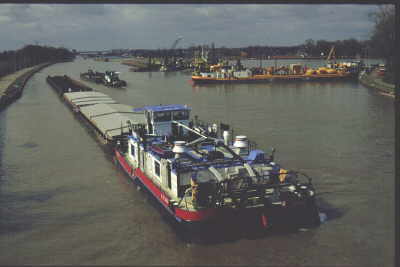
Considering the large development of shipbuilding and due to the obligation to economical vehicles today the high-power engine goods ship (110 m x 11.40 m x 2.80 m) and the zweigliedrige thrust federation (185 m x 11.40 m x 2.80 m) are put to the extension of the channel at the basis.
 The
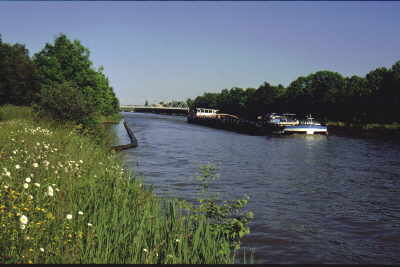
development of the channel contains its widening and recess under
maintenance of traffic as well as the building of resoling and bank
stabilizations, which withstand the loads from the today's and
prognosticated traffic. Because of the widening of the cross
section were further a renewal of all bridges necessary, whose span was
not sufficient any longer, as well as a new building of all passages
and Dueker, with which neither the length nor the necessary cover were
to be brought with the development goals in agreement. The past
passage height under the bridges of 4,00 m was increased on 5,25 m.
The
development of the channel contains its widening and recess under
maintenance of traffic as well as the building of resoling and bank
stabilizations, which withstand the loads from the today's and
prognosticated traffic. Because of the widening of the cross
section were further a renewal of all bridges necessary, whose span was
not sufficient any longer, as well as a new building of all passages
and Dueker, with which neither the length nor the necessary cover were
to be brought with the development goals in agreement. The past
passage height under the bridges of 4,00 m was increased on 5,25 m.
The development of the central land channel (without pass channels) was in the meantime finished placed west to the air-lock Suelfeld. Extensive work to the road support and implemented to the new building of fly-over junctions to time in 80 km are enough for east attitude between Suelfeld and Magdeburg. Also in Suelfeld in the coming years a new air-lock is built. The development of the central land channel belongs here to the project 17 of the traffic projects German unit.
 After the re-establishment of the
German unit 17 traffic projects became already German unit with key
functions for growing together the old and new Land of the Federal
Republic-decided in the spring 1991 of the Federal Government.
These traffic projects cover nine rail projects, seven road projects
and a water way project, i.e. the development of the connection from
the area Hanover to Berlin (project 17). The development of the
MLK of the air-lock Suelfeld to Magdeburg, the channel bridge is
intended over the Elbe with Magdeburg including air-lock new buildings
in Rothensee and Hohenwarthe, the development of the Elbe Havel
channel, the water-structural measures in the range of the lower Havel
water way and the Havelkanals and the binding of Berlin over a north as
also over a south route.
After the re-establishment of the
German unit 17 traffic projects became already German unit with key
functions for growing together the old and new Land of the Federal
Republic-decided in the spring 1991 of the Federal Government.
These traffic projects cover nine rail projects, seven road projects
and a water way project, i.e. the development of the connection from
the area Hanover to Berlin (project 17). The development of the
MLK of the air-lock Suelfeld to Magdeburg, the channel bridge is
intended over the Elbe with Magdeburg including air-lock new buildings
in Rothensee and Hohenwarthe, the development of the Elbe Havel
channel, the water-structural measures in the range of the lower Havel
water way and the Havelkanals and the binding of Berlin over a north as
also over a south route.